clearclassicsblogpost 47.
=====================================================
Una Troy had a fame, or notoriety, in her own time that surpassed that of many of her contemporaries. Her books were translated into several European languages (they were very popular in Germany) and one was even made into a film. In this blog I want to write about two of her 1950s novels which treat light-heartedly two aspects of Ireland’s twentieth-century past usually seen as grim and traumatic. We Are Seven (1955) is about a family of ‘illegitimate’ children being reared by their hard-working mother. The Workhouse Graces (1959) is about nuns running a crumbling institution.
In We Are Seven, Bridget Monaghan and her seven children, who should be a standing reproach to the community – the fathers of five of the children (including twins) are well-known to everybody, but don’t support their offspring financially – are instead a community irritant. The children are well-fed, well-reared, hard-working and respectable; we find out about them through the device of a teacher explaining them to the Inspector, who has been charmed by the bold and forward Daniel, aka ‘Toughy’ in the classroom. Toughy’s father is a local man who had a brief affair with Bridget after his wife became depressed when she found out she couldn’t have children; the twins’ father is the local grocer, who subsequently married ‘respectably’ and had three more sets of twins with his wife. (Twins don’t run in the male line: Mr Bates’ reproductive peculiarity is one of the ‘fantastic’ elements of the story.) The film-mad 9-year-old Pansy(to her mother’s mortification) extracts hush-money (small sums, for sweets) regularly from her scholarly, antiquarian, unmarried father by calling him Dada dramatically in the street. Pansy is ‘discovered’ and makes it onto the screen as a child actor, with her father’s long-suffering sister Johanna going to London with her as her guardian. The second-eldest, Tommy, goes to work as a labourer for his own father, Jamesy Casey, a hard-bitten, selfish farmer, who quickly softens towards him- Casey is also (it turns out) the father of Bridget’s youngest, Pius. A group of concerned local women try to get the children committed to an Industrial School, but the judge won’t commit them because they are palpably not neglected. Then a group of men including the four fathers, get together to buy a farm far away in Kildare (the story is set in Waterford) for Bridget and her family. In the end (spoiler alert) Bridget marries Casey, and she, Tommy and Pius move to the farm in Kildare, Toughy’s father and his wife adopt him, the clever twins (a boy and a girl) who have won scholarships to boarding-schools are more or less adopted (in the holidays) by Miss Kelly, the local teacher, Pansy is in London and the eldest, Mary (17), gets married to a local shopkeeper/publican. The tone is light-hearted, the plot resolutions foreshadowing Maeve Binchy’s gloriously optimistic outcomes (I’ll write about Maeve again), but the cynical reader can note that the community gets its wish: Bridget’s family has indeed been broken up, and tidied away out of sight. As one character remarks early in the book, they’re nice children, ‘The only thing anyone has against them is that they shouldn’t be here at all.’ Despite its neat ending, the book was banned in Ireland.
One well-known woman in mid-twentieth-century Ireland who had seven ‘illegitimate’ children, was Moll McCarthy of New Inn, Co. Tipperary, who was murdered (shot dead) in 1940. After a hurried, botched investigation, an innocent man, Harry Gleeson, was hanged for her murder in 1941. He was posthumously pardoned in 2015; the murderer was never apprehended. Una Troy’s father, a judge, had refused to take McCarthy’s children into care while their mother was still alive, deeming them to be well-looked-after, as no doubt they were. Mothers of multiple children by different fathers were not unknown in Ireland at this time. My mother told me of a woman in the midlands who never married and had three sons with three different surnames, in the 1930s-50s. Their fathers ‘named’ and supported them but none of them could marry her ‘because of land’. She wasn’t shunned or ostracised in any way. Maybe the fathers’ acknowledgment made all the difference.
The Workhouse Graces is also set in a small Waterford town. It is rare that nuns were depicted in fiction in Ireland up to the 1970s, despite their ubiquity in the educational, welfare and health-care scene. (Kate O’Brien’s novels are exceptional in this regard.) When the book opens Sisters Peter, Paul and Borgia are all very old. They ran the workhouse infirmary before it became the County Home at independence some 30 or so years before, and now they have only one centenarian inhabitant. They live (as nursing sisters often did) on site, apart from their home community in the town, and have become so fond of their independence that they don’t want to go back to the main convent, but local businessmen have their eye on the workhouse site for a factory making religious statues. The nuns belong to the fictional Order of Grace (hence the book’s title, which is also a reference to the Three Graces; the title of the other book is a reference to the Wordsworth poem). As elderly nurses, the sisters run an unofficial health clinic, but they also listen to the problems of the townspeople. Jane, the teenage daughter of freethinkers who yearns to be conventional; the wife and son of the Goddy, a notorious drunk and thief; Melly, the secretary of the unscrupulous, popular young local doctor; Simpson, the returned Yank, who was born in the workhouse and whose mother the nuns helped to get away to America with her young child. Girlie, the spoiled daughter of the shopkeeper, and retired actress Bessie are more threads in the tapestry, a young journalist is writing a novel, there is a homicide and there are several romances.
Despite the fact that the nuns who ran institutions in 1940s, 50s and 60s-Ireland had a reputation for strictness (at best) and cruelty and neglect (at worst), The Workhouse Graces with its stubborn old hold-outs has more claims to realism than We Are Seven. Just as in We Are Seven, sending the children to the Industrial School is proposed as a modern solution to social untidiness, closing the casual ward of the former workhouse in favour of the bright and up-to-date, but more strictly-run County Home, is portrayed as a step forward. It’s the classic conflict between the old, comfortable, personal but often ‘inappropriate’, unsafe, unmonitored caring facility and the new one with regulations and regularly rotated and rested staff, vetting and supervision and a carefully-worded mission statement. When I worked with homeless people in the 1970s and 80s, the rough-and-ready casual wards of former workhouses presided over by very old nuns here and there throughout the country were highly-prized places of recourse of the fraternity of the road, their location knowledge which was not readily shared with all and sundry. In Loughrea (if I remember rightly)an elderly nun used to give every overnight stop-over a bottle of stout. Up to the 1980s Irish nuns were pretty much a law unto themselves, and the devastating results of that lack of oversight have been documented (slowly and painfully) in commissions of inquiry into Magdalen asylums, mother-and-baby homes and Industrial Schools. But nuns’ freedom to act and 24/7 devotion to duty had benign effects too, as many people who benefitted from their educational efforts could attest.
In the story of Moll McCarthy’s murder, the shocking miscarriage of justice which led to the death of an innocent man often overshadows the murder victim herself, a young woman cruelly done to death. The four youngest of the children she left behind her were sent to Industrial Schools where, if accounts of those places are anything to go by, they were probably reminded more than once in negative terms of their mother’s character and eventual fate. It is hard to forget about this real family and what happened to them when reading Troy’s fairy-tale. So, even though We Are Seven is amusing with clever plot resolutions, it isn’t heart-warming – or it isn’t for me, anyway.
The Workhouse Graces is – for early twenty-first century readers – a refreshing portrayal of nuns to set against the almost universally negative portrayal now current, but it falls between being the story of a small-town community (most of whose characters are comic stereotypes) and the story of a small religious community. I don’t know why, but with the best will in the world, it simply doesn’t work for me and the only feeling I had closing the book was relief that I had finished it.
I never tire of re-reading Kate O’Brien (banned and unbanned), Maura Laverty (ditto), John D.Sheridan, Mary Lavin, Francis MacManus, Norah Hoult, Mary Purcell, Elizabeth Brennan, Sheila Pim and Annie M.P.Smithson. But it was a penance to re-read Una Troy for this blog and I’m not sure why. She was a prolific, hard-working and fluent writer, who had a long writing career (she wrote under the name Elizabeth Connor in the 1930s) and she was not afraid to defy the norms of her time in the themes she tackled in her books. Married to a doctor in Clonmel, she combined a very conventional middle-class life with a writing career. (As did many other female writers of her time, in fairness.) And I’m only discussing two of her books here, because their themes are controversial ones. Her books could and should be republished for a modern audience, because she has a lot of witty and insightful things to say about life in 1950s Ireland.
Una Troy, We Are Seven (London: Heinemann 1955; New York: Dutton 1957). It is the American edition I have, with charming illustrations by Vasiliu, who was, apparently, a former Russian diplomat who defected to the United States. (I googled him.)
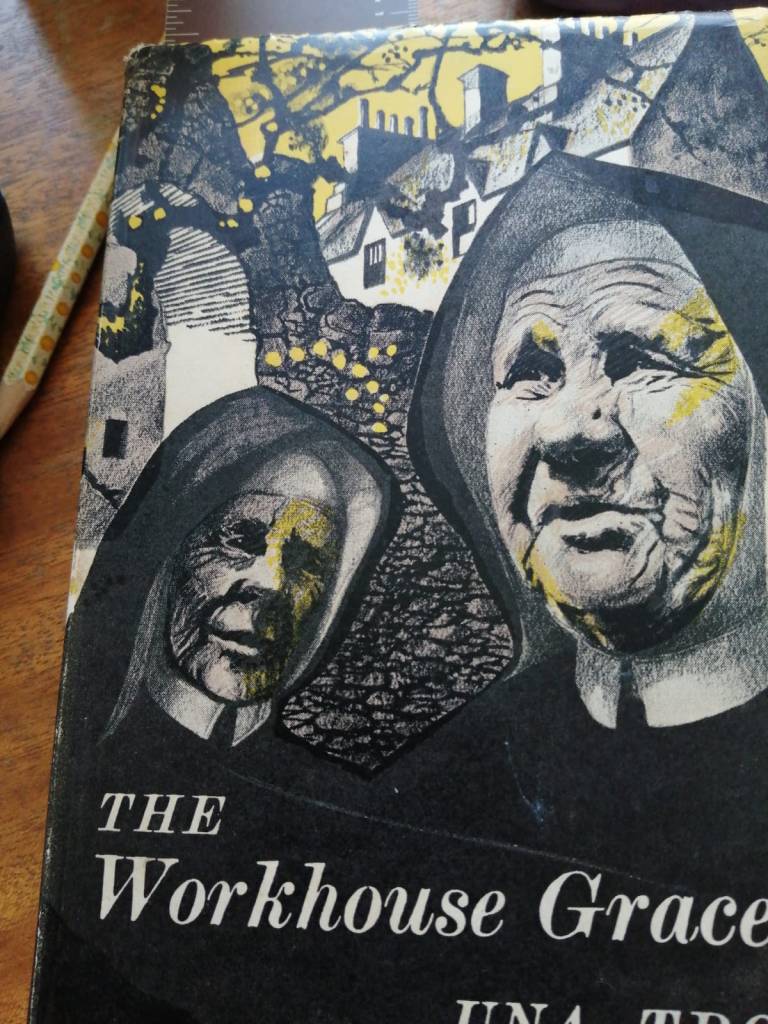
_____ The Workhouse Graces (London: Heinemann 1959). The copy, which I bought on amazon, has the original dustjacket (above).
Sinead Gleeson (ed.) The Art of the Glimpse: 100 Irish Short Stories (London: Head of Zeus 2020); containing Elizabeth Connor/Una Troy’s ‘The Apple’, first published in 1942. This is a highly enjoyable and refreshingly unpredictable collection.
Marcus Bourke, Murder at Marlhill: was Harry Gleeson innocent?(Dublin: Irish Geography Publications 1993).
Entry on Una Troy in the Dictionary of Irish Biography (Patrick Maume).


Leave a Reply